

The age of reason: When Armorik and Rozelieures defy time

For a long time, French whisky was perceived as a ‘youngster’: lively, focused on fruit and terroir, but sometimes lacking the depth that only decades in the cask can offer. Today, those days are over.
With the launch of their 18-year-old vintages, the Armorik and Rozelieure distilleries are not just releasing prestigious bottles; they are asserting France's legitimacy on the world map of high-end spirits.
So, while some journeys are measured in kilometres, mine will be measured in decades.
For this new journey, I enlisted Bradpeat, my faithful travelling companion, for a cross-country trip through France. The goal? To pay tribute to two iconic figures in French whisky, David Roussier and Christophe Dupic, and above all, to taste the fruit of their patience: their 18-year-old vintages. This is not about making comparisons, but rather demonstrating that France no longer has anything to be ashamed of when it comes to its cousins across the Channel.

Stage 1: Lannion, David Roussier's garden

Arriving at Warenghem in Lannion (Brittany) is a bit like coming home, but more importantly, it's like coming home to a century-old family institution.
The sea air from the Pink Granite Coast rushes into Bradpeat as soon as I open the door of my van. David welcomes me with the simplicity that characterises pioneers. Here, they don't just play at making whisky, they've been crafting it since 1998.
The 18-year-old whisky he's about to introduce me to is the culmination of a vision that began two decades ago: to prove that Breton character can rival the biggest names in Scotland.
Armorik 18 years old: The Balance of Breton Humidity

The Breton climate, with its low temperature range, allows for long ageing without excessive evaporation of water (which would increase the alcohol content). Here, we have worked on a high-precision blend.
Since 2007, this 18-year-old whisky has been based on a dual architecture:
* Ex-Bourbon casks form the backbone. Here, the American white oak has already been ‘broken in’ by a first passage of Bourbon. It brings a vanilla structure and milky sweetness without overwhelming the floral Armorik distillate.
* Ex-Oloroso sherry casks, which are David's signature on his old age statements. The more porous European oak brings tannins and a mahogany colour. The deep impregnation of sherry into the wood fibres releases caramelised notes and complex phenolic compounds after 18 years.
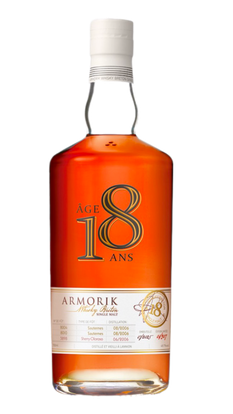
This ‘old’ whisky, bottled at 48.7% ABV, is an invitation to indulgence.
On the first sip, you will find pronounced notes of dried fruit (figs, dates) with a hint of rancio and spices tickling the nose.
On the second nose, there is a hint of candied citrus, first orange, then mandarin, which brings freshness.
The third nose is more woody, slightly waxy, but still dominated by sweet notes.
The attack on the palate is silky. Breton butter caramel (salty, of course). First, we find sweet notes and a hint of salt, but also a woody base.
This is followed by a surge of spices that tingle the mouth but quickly subside to give way to beautiful notes of candied fruit. On the finish, while these sweet notes linger on the palate, more woody and dry notes coat the tongue.
The finish is long and warm, leaving a slightly peppery, marine impression, the distillery's unmistakable signature.
The empty glass retains beautiful traces of candied fruit and rancio notes.
Between Lannion and Rozelieures, France rolls by. Bradpeat purrs along the country roads. This journey is the perfect metaphor for ageing: you have to give time time, appreciate the scenery between two stages of character.
Stage 2: Rozelieures, Christophe Dupic's volcano

The scenery changes. The hills of Lorraine replace the cliffs of Brittany. At the Grallet-Dupic family's home, we have our feet on the ground and our heads in the still.
Christophe and his entire family welcome me with a passion for the grain and fruit they grow themselves. Here, whisky is a matter for farmer-distillers, a complete vertical loop. As ‘harvesters-distillers’, they control everything here, from growing the barley to distilling it.
Christophe has transformed the family farm into a laboratory of excellence. At Rozelieures, they master peat, tame exceptional wine casks, but above all, they wait for the Lorraine terroir to infuse the spirit.
This 18-year-old is the pinnacle of their pyramid, a distillate that has survived 18 harsh Lorraine winters.
Here, time has not only softened the fire of the still; it has sculpted an aromatic complexity that is rare for a French whisky.
Rozelieure 18 years old: Mastery of Amplitude Lorraine

At Christophe's, the challenge is different than at David's. In Lorraine, summers are hot and winters are harsh. The ‘push and pull’ (the movement of the distillate entering and leaving the pores of the wood under the effect of temperature) is much more aggressive than in Brittany. However, Lorraine opted for a more raw distillate presented at 53.2% ABV.
Christophe takes advantage of his position as a grower to experiment with single vineyard wines, but for the 18-year-old, it is the nobility of the oak that prevails:
Christophe pays particular attention to the origin of the wood, and the influence of the local forest (Haye) is often evident, but for this age statement, the use of French wine casks (particularly from the grands crus of Sauternes or red wines) is decisive.
At the same time, 18 years ago, he experimented with medium-plus toasting, which allowed the wood to be charged with vanillin and roasted notes, and at the time chose a slightly peated malt (6ppm) for his distillate. With time, we will see if, logically, it has polymerised with the tannins in the wood to create aromas of leather and cold tobacco.
This ageing process also produces beautiful, intense amber colours.
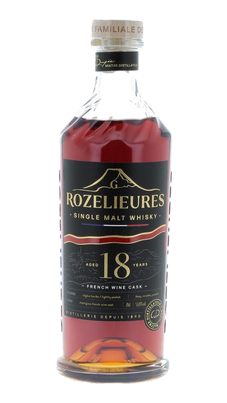
When you put your nose in the glass, you are immediately struck by a woody and fruity complexity. You can quickly detect notes of cocoa and a few subtle spices.
It is the second pass that reveals notes similar to those of peat with leather, cold tobacco, and an extremely subtle, almost evanescent veil of smoke.
On the third sniff, the notes of stewed red fruit return, but above all, spices.
The palate is rich, complex and refined.
It is marked by flavours that are initially sweet with red fruit, then similar to the dry texture of nuts, followed by prunes and finally mirabelle plums (recognisable notes of Rozelieures from that time). Next, we discover the tannic notes brought by the wine casks, before an explosion of spices coats the palate. The finish becomes drier and woodier.
The long and majestic finish lingers with subtle nuances of red fruit, followed by distilled orchard fruit.
If you have any doubts about the slightly peaty character of this distillate, try the palm test. You will discover light smoky notes that envelop the broad barley notes.
Just like in the palm, the empty glass reveals very light peaty notes, but this time they envelop the mirabelle plum notes.
Conclusion: France comes of age
Whether at David's in Brittany or Christophe's in Lorraine, the conclusion is the same: French whisky has come of age. These two 18-year-old bottles do not seek to copy Scotland. They assert their own identity, built on patience and friendship.
As I close the doors of Bradpeat to hit the road again, one thing is certain: with ambassadors like these, French whisky has nothing left to prove, except its ability to transport us to faraway places with a single glass.
If you come across a van smelling of malt and peat on the roads of eastern or western France, it's surely Bradpeat continuing its quest for angels. See you soon!