
Kanosuke: when shōchū is transformed into a fine Japanese whisky

On the immaculate roads of the island of Kyūshū in southern Japan, Bradpeat’s engine purrs softly, as if it were trying to be discreet and had fallen in step with Japanese culture. Today, we set out to discover KANOSUKE, its history and its production.

This is our chance to discover the distillery (or distilleries)!! and their products: KANOSUKE HIOKI POT STILL, KANOSUKE SINGLE MALT and KANOSUKE DOUBLE DISTILLERY! But who knows, perhaps we’ll also get the chance to taste some SHOCHU?
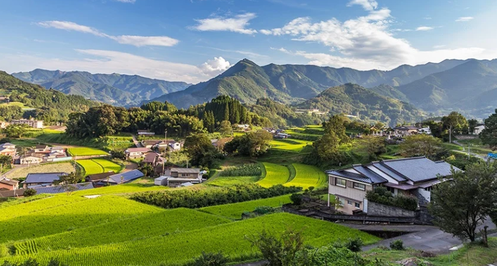
Heading towards the coast of the East China Sea, but before reaching Fukiagehama Beach, I turn inland.
The light is different here. Softer, warmer. The hills undulate gently in the breeze, and somewhere between the fields and villages lies the true starting point of this story.
To really get to know the Kanosuke distillery, I must first discover its history. A first stop is a must: HIOKI.
Hioki – where it all began
Hioki is not a spectacular distillery.
No stylish façade, no floor-to-ceiling windows overlooking the ocean. Here, everything is more understated. Older. More deeply rooted.
Yet it was in this region that the Komasa family’s story began in 1883.
At the time, whisky was not on the cards. The family produced shōchū, that traditional Japanese spirit deeply rooted in the local culture.
A gentle, almost sweet scent of fermentation hangs in the air. You immediately realise that time has never really left this place.

It all began in 1883 when the Komasa family founded a distillery specialising in shōchū.
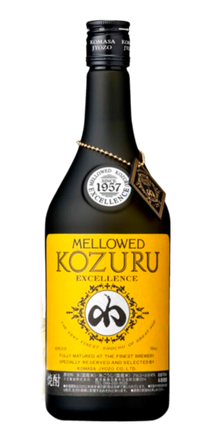
The first master distiller, Ichisuke, produced a rice shōchū that was considered a luxury. Then came the second generation, led by Kanosuke Komasa, a key figure after whom the distillery would later be named. A visionary, in 1957 he introduced one of the first shōchūs aged in oak barrels (a heresy at the time, but one that is now recognised): Mellowed Kozuru, a revolution in a world still largely unconcerned with long-term ageing.

The dream, however, extended beyond Japan. It was not until the fourth generation, Yoshitsugu Komasa, that the ambition took a new direction. The problem was that shōchū remained a local product and struggled to gain a foothold internationally, so he turned to a universal language: whisky.
In 2017, on land steeped in family history, he founded the Kanosuke Distillery.
Production began in 2018, marking the birth of an unconventional player on the Japanese whisky scene. But we’ll come back to that later.
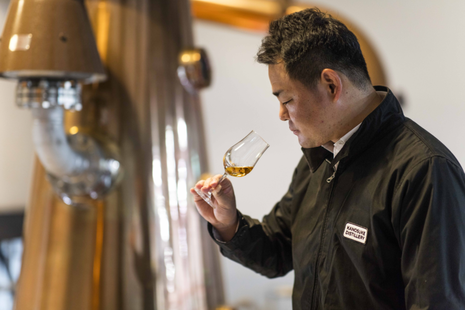
Hioki: from shōchū to whisky – a distillation bridging two worlds
At first glance, the Hioki distillery does not look like a modern whisky distillery. And that is precisely what makes it so fascinating.
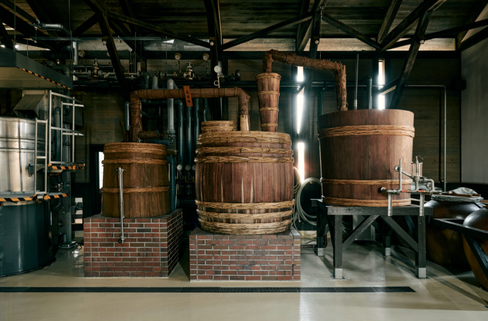
This is not a site built from scratch to produce whisky, as one might see in Scotland or even in the new wave of Japanese distilleries. Hioki is first and foremost a historic shōchū distillery, whose facilities have been adapted and upgraded to accommodate whisky production.
One of the distinctive features inherited from shōchū lies in traditional Japanese fermentation. Water plays a central role here: it comes from groundwater filtered through the region’s volcanic soils, imparting purity and minerality to the distillate, which is then combined with a long fermentation process and expertise honed over more than a century of practice.
In fact, just for a change, why not start by trying some shōchū?
First of all, are you familiar with shōchū?
It is a spirit produced as part of a long tradition of craftsmanship dating back to the late 19th century. It is mainly produced from sweet potatoes, but sometimes also from barley or rice, depending on the vintage. The production process relies on a fungus derived from koji, which is essential for converting starch into fermentable sugars, followed by fermentation and then distillation, usually in a single-batch still. The one we are going to taste today is made exclusively from rice.
Here, we have a date with history. Indeed, the rice-based Shochu Mellowed Kozuru is the very same spirit with which it all began after the Second World War. It is aged for six years in oak casks and has an alcohol content of 41%.
SOCHU TASTING
On tasting, Hioki shochu stands out for its subtle, almost crystalline nose. It is characterised by notes of very lightly caramelised cooked rice. One then discovers more floral notes and a slightly lactic hint of cooked sweet potato, accompanied by subtle fermented notes reminiscent of yeast. Finally, one can detect more fruity nuances, such as those of ripe banana.
On the palate, the attack is smooth but quickly gives way to a full-bodied, rounded structure, with a surprisingly slightly oily texture. The rice grain comes through with a smoothness accompanied by a slight sweetness.
The finish, of medium length, prolongs this experience with earthy, cereal-like and delicately sweet notes, with a well-integrated alcoholic warmth that leaves a velvety sensation on the palate (the famous ‘Mellow’) and a very slight astringency in the throat.

At the heart of Hioki lies an organisational structure typical of traditional Japanese distilleries: fermentation areas designed specifically for shōchū, robust, functional equipment—often made of stainless steel—and a seasonal production cycle.
Hioki uses its facilities on a cyclical basis: shōchū remains the priority, but whisky production now takes place during the quieter periods.
One of the most striking features of Hioki’s facilities is the choice of stills. Here, there are no large copper pot stills like those now found in its new distillery; Hioki mainly uses vertical, relatively straight stainless steel stills, directly inherited from shōchū production (double vacuum distillation and lower distillation temperatures, which ultimately result in a rounder, less harsh texture, producing a creamier whisky).
Since 2020, the distillery has held a licence to produce whisky, including grain whisky, in addition to malt whisky. It also produces its own grain spirits and has complete control over its blends. It therefore produces spirits made from both malted and unmalted barley.
There’s no better way to find out than by tasting the Hioki Pot Still!
Tasting notes for Hioki Pot Still
The Kanosuke Hioki Pot Still perfectly embodies the spirit of innovation that drives Japanese whisky today. Behind this bottle lies a unique approach, at the crossroads of cultures: the influence of Irish pot still whiskies, the Japanese tradition of shochu, and maturation in bourbon and American white oak casks.
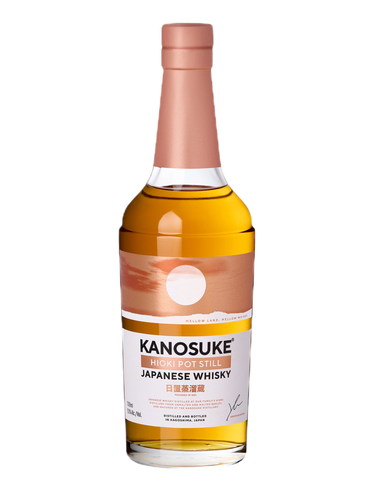
From the very first glance, its golden colour with amber highlights hints at a certain richness.
The nose immediately confirms this impression with a rich and inviting bouquet. There are notes of fresh pastries, reminiscent of butter biscuits or a still-warm madeleine. As the whisky opens up, more fruity aromas emerge — apricot, plum — accompanied by a touch of citrus that brings freshness. A slight milky, almost creamy quality (undoubtedly resulting from the production method) rounds out the profile and reinforces this sensation of smoothness.
On the palate, the attack is supple but quickly becomes full-bodied. The texture proves particularly interesting: round, almost oily, it envelops the palate without feeling heavy. The pastry-like flavours are confirmed with notes of vanilla and caramel. One can detect a hint of saltiness and a woody, very slightly spicy finish. The alcohol, despite being 51% ABV, is well integrated, contributing to the structure without ever dominating.
The finish follows on seamlessly, with a lovely length marked by notes of vanilla, sweet ginger and slightly spicy oak. There is a certain freshness that fades to give way to a warm and elegantly dry sensation.
Hioki’s facilities really come into their own when viewed within the distillery’s overall ecosystem: Hioki is not conceived as an isolated distillery, as it produces a specific and complex spirit.
But despite this expertise, a limitation becomes apparent. Shōchū remains difficult to export (did you know that?). This is where the fourth generation, Yoshitsugu Komasa, comes in.
His idea is simple, almost obvious: to use the universal language of whisky to bring the soul of shōchū to the world. But to do that, a new venue is needed!
Towards the sea – KANOSUKE, the distillery nestled between the sea and the extremes
So I set off again towards the East China Sea. It takes just a few kilometres to find myself in a whole new world – the ‘Mellowed World’. I only have to step out of the van to realise it: the wind picks up and the air turns mild and salty.
Before me, Fukiagehama beach appears, vast and luminous. And there, facing the ocean, almost surreal against this backdrop, stands the Kanosuke distillery, founded in 2017 (and in production since 2018).
I don’t know why, but although my first encounter with Kanosuke took place in Scotland (yes, really), I had the chance to discover the power and smoothness of the 2020 Newborn. It was an unreal experience in the land of Scotch, and discovering the place of its birth seems even more surreal.
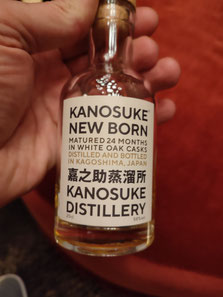
What immediately strikes you about Kanosuke is its terroir.
Here, the distillery isn’t nestled in a misty valley like in Scotland. It faces the ocean, on a windswept coast. Fukiagehama Beach, one of the largest in Japan, sets the pace: intense light, constant sea spray, marked temperature fluctuations. It is even said that one can admire the most beautiful sunset in Japan there.
Summers are hot, almost too hot. Winters are surprisingly cold. This contrast accelerates maturation, increasing the ‘angel’s share’ and intensifying the interaction between the wood and the distillate. The casks are scattered about, some half-buried, others exposed to the sea winds. Each barrel has its own unique story.

A hybrid production, blending Japanese tradition with modern innovation
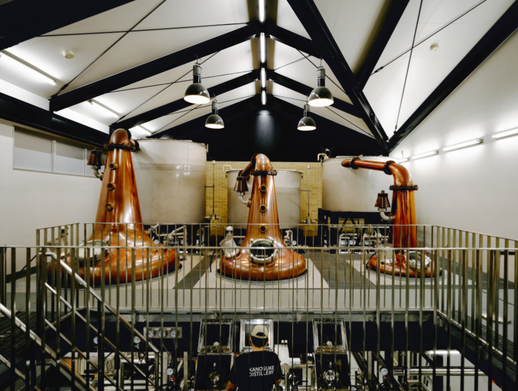
When you visit the distillery, it’s as if you’re stepping from one century into the next. Gone is the stainless steel; the heart of the distillery is built around three gleaming copper pot stills (enough to put many a distillery to shame).
In a world where two stills are often enough, Kanosuke has three, each with a different shape to create three distinct distillate profiles, which are then blended to form an aromatic palette.
Nevertheless, the house’s DNA remains deeply rooted in shōchū, with techniques derived from this spirit and the use of re-charred ex-shōchū casks to achieve a ‘mellow’ texture (the house’s signature).
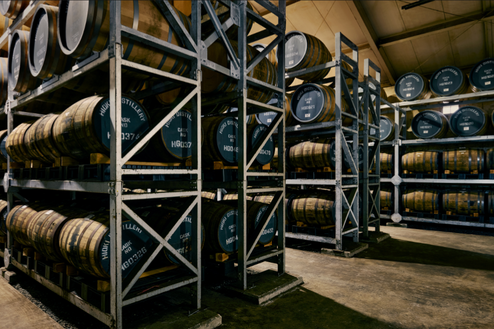
As for the maturation of their whiskies, the two distilleries have three ageing cellars situated very close to one another, which are able to make the most of the wide temperature variations (it is worth noting here that the weather is mild in winter but quite hot and humid in summer): one exposed to the elements, one with controlled, airtight conditions, and a third, underground, where the great spirits of tomorrow are left to mature.
Kanosuke Single Malt Tasting
There’s no better way to appreciate this single malt than by tasting it.
Kanosuke Single Malt reflects a sunny, coastal environment that subtly influences its profile. Here, there are no dramatic flourishes, but rather a refined, elegant composition where every element seems perfectly in place.
To the eye, it boasts a brilliant golden colour resulting from maturation in five types of cask (including, notably, bourbon casks and thus ‘Mellowed’ shichu). This maturation brings complexity and depth.

The nose opens delicately with aromas of ripe fruit — peach, apricot — quickly joined by sweeter notes of honey and vanilla.
As it breathes, it gains depth with more spice and, above all, woodier and very slightly smoky notes.
On the palate, the attack is silky. Fruity flavours dominate at first, before giving way to more pastry-like notes — caramel and vanilla. These are, however, quickly replaced by a slight salty and spicy tension that energises the whole. The 48% alcohol is perfectly integrated.
The finish is quite long, leaving notes of yellow fruit on the palate and a subtle woody dryness with a hint of liquorice right at the very end.
Kanosuke Double Distillery Tasting
And to round off our tour, why not conclude with the union of the two distilleries and a blend that brings together all of KANOSUKE’s expertise?
Kanosuke Double Distillery is a blend of Hioki’s pot still whisky and Kanosuke’s single malt.
This fusion is also a collaborative endeavour, as it is the work of the two brothers, Yoshitsugu and Kiichiro Komasa. The aim is not to blur these identities, but rather to bring them into dialogue in a sort of ‘happy medium’, a harmony between elegance and power.
To the eye, it has a clear, slightly deep amber colour, immediately evoking a whisky that is structured yet approachable.

The nose opens generously with notes of sweet vanilla and fruit (apricot, peach) — typical of the single malt — accompanied by the subtle malty notes of the pot still. Together, these give it a pleasant biscuity note. As it breathes, it reveals fresher notes (almost minty) but, above all, a slight smoky edge.
On the palate, the balance comes into its own. The attack is rich, smooth and mellow, underpinned by a distinct malty sweetness. Very quickly, notes of spice (clove and cinnamon) tingle the tongue. It finishes with sweet mandarin notes.
The finish is long and consistent: of medium to long length, it blends ripe fruit with fresh and woody notes. It leaves a warm impression with a hint of dryness and notes of liquorice.
Night has now fallen. The sound of the waves accompanies the last few drops in the glass, and I find myself thinking that Kanosuke is not a Japanese distillery like any other. It doesn’t follow the classic Japanese whisky tradition and will be producing whiskies that are more dynamic than those we’re used to in the Land of the Rising Sun, yet remain smooth (and are well worth discovering): that is surely the MELLOWED spirit.
Bradpeat sets off again, leaving the East China Sea behind. Onwards to the next distillery.