The Dalmore: 17 Years Old and the Reimagining of a Distillery
There are distilleries you visit… and others you admire from afar, almost with a sense of regret.
In my Bradpeat van, I was driving along the B817 on my way back from a magnificent tour of the Northern Highlands when I passed the legendary Dalmore Distillery, perched with an almost arrogant elegance on the shores of the Cromarty Firth.
And there, frustration. Shutters down. Silence. As I passed, the distillery was closed to the public for renovation work.
But paradoxically, it was perhaps this moment of suspended time that left the deepest impression on me.
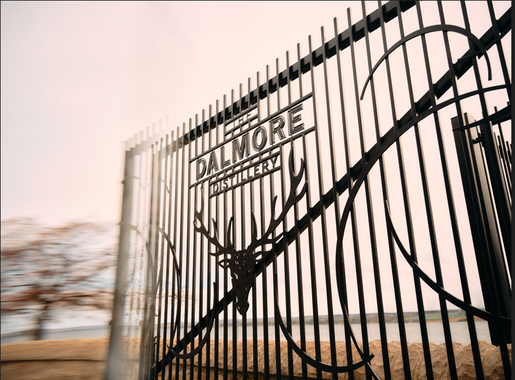
For behind the hoardings and scaffolding, the transformation was already beginning to take shape. The Dalmore wasn’t simply being renovated — it was reinventing itself. A confident, almost theatrical move upmarket.
Glass, steel, light: everything seemed designed to magnify what, here, is almost sacred.
And then, as is often the case on this sort of journey, time did its work.
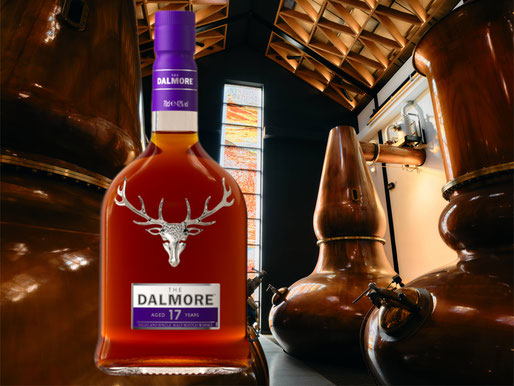
A few months later, the distillery reopened. The industrial austerity of centuries past has given way to modernity; light floods into the rooms housing The Dalmore’s distinctive stills, helping to showcase them
And what we discover is no longer merely a production site, but a veritable cathedral dedicated to whisky.
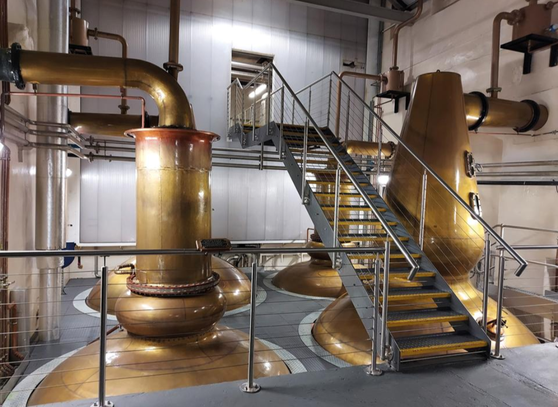
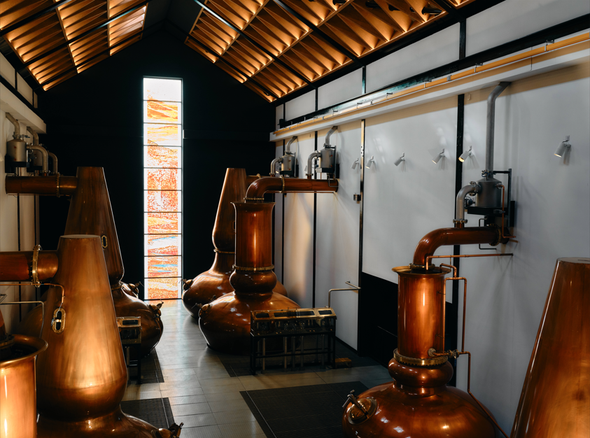
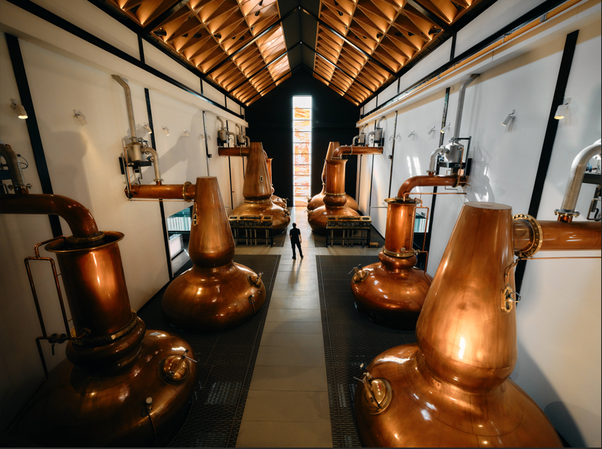
The cellars are beautifully staged, the stills become sculptures, and every space tells a story. The Dalmore hasn’t changed its soul — it has simply brought it to light. Visitors are welcomed by the timber-clad cathedral of the kiln, and sample the rarest distillates in a newly redesigned room.
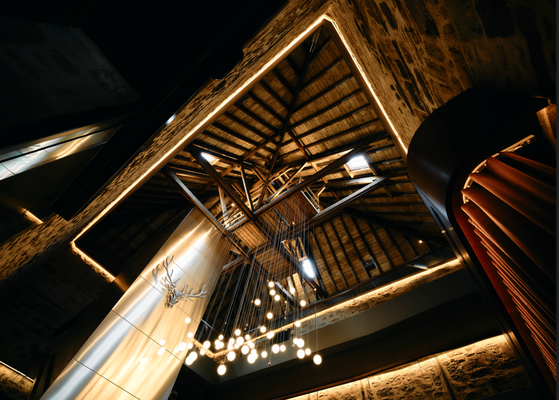
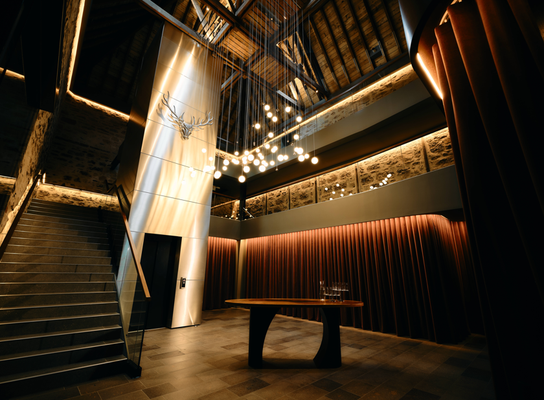
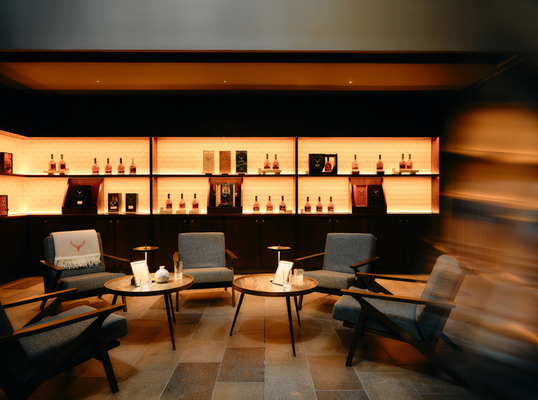
The Dalmore has just been reimagined!
The Dalmore: A Royal Heritage
I don’t think I’ve ever been able to write about a distillery without delving into its history. As you know, I just can’t help myself. And here, even more so than elsewhere.
Because at The Dalmore, it all began long before 1839.
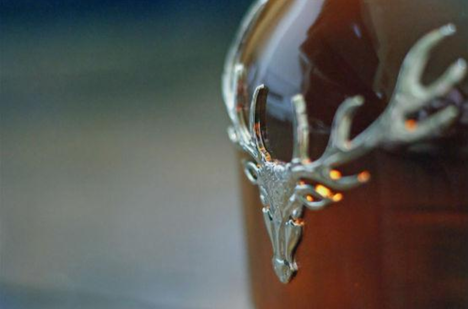
In case you hadn’t noticed (😊), every bottle features that famous twelve-point stag. A mere detail? No. A statement.
Back in 1263. A man, chieftain of the Mackenzie clan, stands between the king and a stag charging at full speed. His action saves the king. As an eternal reward, the clan is granted the right to bear this emblem, and the heroic deed will live on through the ages.

When the Mackenzies took over the distillery in 1867, they didn’t just lend it their name. They left a legacy there.
An exceptional raw ingredient: barley from the Black Isles
Even before copper, even before wood… there is the grain.
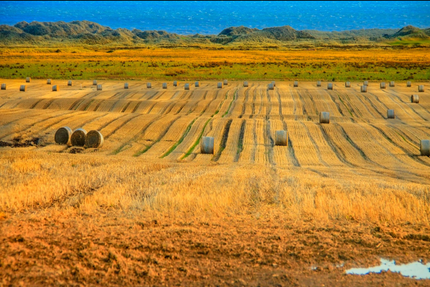
In this age of short supply chains, The Dalmore proves that this has been a guiding principle for it since its inception. Indeed, the distillery sources the majority of its barley directly from the Black Isle, a peninsula situated directly opposite the distillery, on the other side of the Cromarty Firth.
A unique terroir.
There, the sea winds, rich soils and temperate climate produce barley of remarkable quality. A raw material that already possesses a certain balance: between rusticity and finesse.
And somehow, you can sense it right down to the glass.
A hallmark of craftsmanship: the art of detail taken to the extreme
At The Dalmore, nothing is left to chance, and the work carried out at the distillery will further highlight this expertise and this facility.
The distillery’s eight stills are among the most unique in Scotland. With flat-topped wash stills — almost an anomaly — that encourage reflux, spirit stills fitted with water jackets for surgical-precision temperature control (deliberately asymmetrical shapes to add complexity to the profiles) and horizontal condensers that impart texture and density. All this results in a structured, deep, almost tactile distillate.
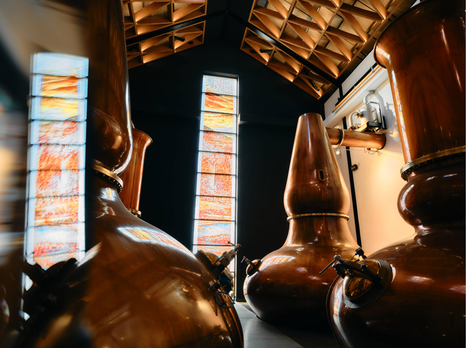
And now, with its contemporary architecture, clean lines and spectacular lighting of the cellars and stillhouse, the distillery is more firmly than ever committed to its positioning: luxury, precision and heritage. A confident move upmarket, almost museum-like in feel, which elevates an already legendary craftsmanship.
The Dalmore: a long history of casks!
With the new The Dalmore 17 Year Old, the distillery has once again sought to share its expertise and offer a taste of the work of time.
But before tasting it, a brief reminder of The Dalmore’s mastery of time and the consistency of its ageing process.
At its core, as is often the case with Scotch whisky, American bourbon casks lay the foundations: vanilla, honey, and roundness. Then comes The Dalmore’s signature.
The work of the sherry cask or the port cask. So let’s talk casks!
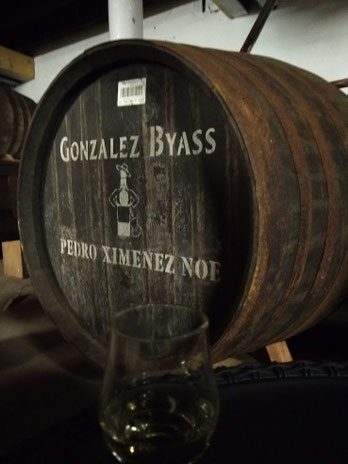
The Dalmore distillery has a long-standing and fundamental relationship with Spanish bodegas, dating back to the late 19th century when the Mackenzie brothers undertook journeys to Andalusia to select exceptional casks.
This initiative led to a formal partnership in 1915 with the renowned González Byass house, based in Jerez de la Frontera. Since then, this collaboration has afforded The Dalmore privileged access to rare casks that have held prestigious sherries, notably very old Olorosos such as Matusalem (which is over 30 years old and features in the 17-year-old expression).
Even today, after more than 100 years of formal collaboration (and nearly 150 years of shared history), these sherry casks form the heart of the Dalmore style, imparting characteristic aromas of orange, chocolate, spices and dried fruit, which define its unique aromatic identity.
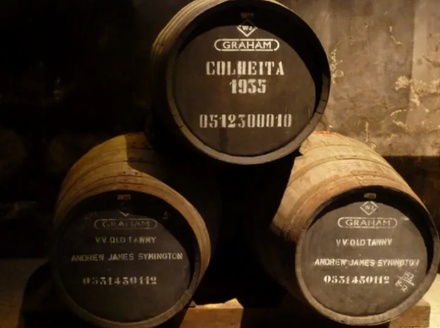
Alongside its historic ties to sherry, The Dalmore has developed an equally strategic relationship with the world of port, having partnered with Graham’s Port since 1974. Here too, thanks to a collaboration that has now lasted for around 50 years, The Dalmore enjoys privileged and exclusive access (it is the only Scottish distillery to do so) to vintage tawny port casks, some of which are extremely old. These impart notes of black fruits, fig, plum, dark chocolate and sweet spices.
The Dalmore 17 Year Old: a three-act symphony
And so here is the new collection unveiled in 2026, with the 17-year-old as its centrepiece.
The base is American bourbon casks for the first 12 years of ageing (enough to impress many and give the spirit its structure).
Thereafter, for the final five years of cask maturation, the whisky is finished in a trio of casks from González Byass: Amoroso (a blend of Oloroso and Pedro Ximénez casks aged over 20 years), which brings a balance between sweetness and a salty edge; Apostoles (Palo Cortado casks aged over 30 years); and Matusalem (Oloroso aged over 30 years).
A blend that seeks not power, but precision, and which gives the distillate its deep amber, almost coppery colour, echoing the stills.
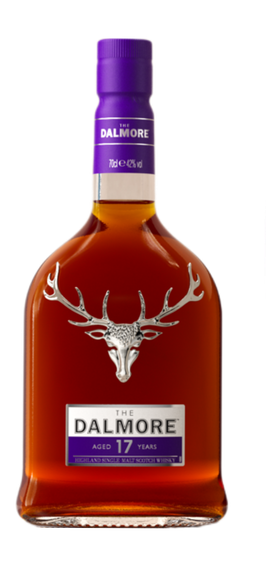
With eager anticipation, I pour, and as with any fine Dalmore, in keeping with Richard Paterson OBE’s teachings (even though here the distillate is the work of Gregg Glass), I say:
‘HELLO’: The nose opens with candied Seville orange, a fragrance directly inherited from the dense distillate produced by Dalmore’s stocky stills, then we discover, more vividly, notes of blood orange zest, like a burst of light brought by the Matusalem sherry casks.
‘HOW ARE YOU?’ On the second whiff, ripe pear gently settles in, round and juicy, evoking the sweetness of American oak accompanied by warm, melt-in-the-mouth caramelised apple, the result of a long rest in bourbon barrels.
‘NICE TO MEET YOU’. On the third pass, gentle spices—cinnamon and nutmeg—gradually rise, as if opening a door to the cellars where the Spanish casks slumber.
Finally, a hint of lightly toasted walnut, heralding a touch of dryness, slips into the background—discreet yet elegant—the signature of Oloroso.
On the palate, the first sensation is that of a fragrant pear, carried by the naturally oily texture of the Dalmore distillate. Next, we discover red fruits — raspberry and redcurrant — which bring a sense of indulgence (typical of Amoroso).
The palate then reveals notes of almost toasty toffee, derived from toasted American oak, before evolving into candied orange marmalade, a hallmark of the Matusalem Oloroso.
A hint of honey glides across the tongue, sweet and floral, evoking the very essence of the spirit, and the journey concludes with notes of sweet almond and cocoa—a subtle legacy of the rare Apostoles sherry.
The finish lingers at length on intense, almost velvety dark chocolate, typical of very old Oloroso casks, and a vinous hint of grape and leather.
An experience as luminous as the distillery’s newly refurbished still room
Je n’ai pas visité The Dalmore ce jour-là.
Et pourtant, j’ai eu l’impression de la comprendre autrement.
Entre fermeture et renaissance, entre histoire et modernité, la distillerie incarne une vision presque architecturale du whisky. Un lieu où chaque détail — du grain des Black Isle jusqu’au choix des fûts — participe à une œuvre cohérente.
Much informations on THE DALMORE Website