

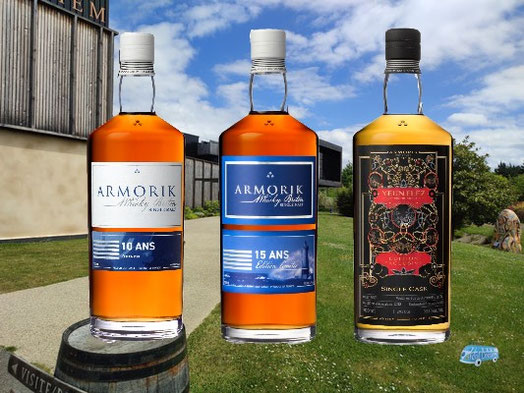
Distillerie WARENGHEM - Armorik 10 yo, 15 yo et Yeun ELez Sherry cask
Some journeys aren't planned. They are felt.
A desire for the open road, the scent of salt in the air, a memory of peat in a glass... and the call of whiskies shaped by the wind and Breton granite.
That morning, I started the engine of BRADPEAT, my trusty van and mobile haven. Destination: Lannion, in the Côtes-d’Armor, for a meeting with a living legend: the Warenghem Distillery.
But before stepping into the warehouses and tasting the ARMORIK 10 Year Old, ARMORIK 15 Year Old, and YEUN ELEZ SINGLE CASK N° 8366, a stop nearby was a must.
Benjamin Lefloch : master of wood and fire
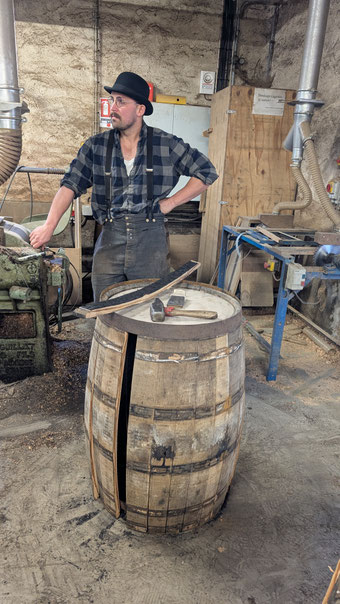
In the heart of Lannion, just a stone's throw from the distillery, within the reinvented space of the former slaughterhouses, the clear sound of mallet on oak resonates. This is where Benjamin Lefloch works, master cooper, his bowler hat perched firmly on his head—a timeless figure at the heart of a workshop where wood lives and breathes.
His artisanal cooperage, handed down through generations, upholds a rare craft. Barrels are handcrafted, machined on antique and tireless machines, toasted over an open flame, and hooped with respect for tradition. Benjamin supplies barrels to the Warenghem Distillery, sharing a common dedication to precision and terroir.
From abandoned site to spirited revival
This once-industrial site is now set to become a vibrant hub of brewing and distilling culture in Trégor. Warenghem is developing two ambitious projects: a tasting bar, to explore whiskies, liqueurs and in-house creations, and a microbrewery, currently being outfitted, which will house already-acquired micro-brewing equipment.
Conceived as a living extension of Warenghem's spirit, this future brewery will craft small, experimental, local batches full of character.
A century-old story: Warenghem Distillery
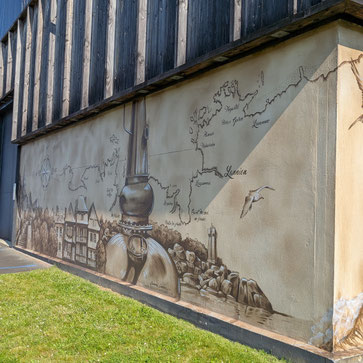
To understand the uniqueness of Warenghem, one must turn back time.
It all began in 1900, when Léon Warenghem, a Flemish registrar passionate about plants, set up his stills in Lannion. There, he distilled a medicinal liqueur called Elixir d’Armorique—a blend of herbs and spices that quickly gained popularity. The business later expanded under his son Henri with fruit liqueurs and fine creams, still crafted on-site.
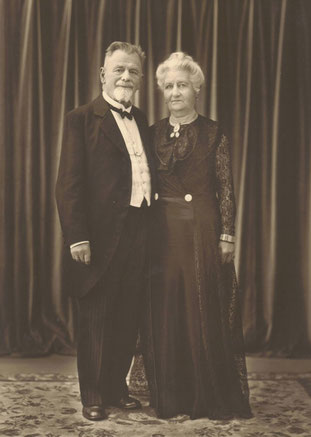
But it was in the 1980s that the distillery made a bold shift under the leadership of Gilles Leizour: toward whisky.
A pioneer in France, it began with a blend (WB), before launching the first Breton single malt in 1998: ARMORIK.
Since then, the range has grown to include expressions matured in Breton oak, organic editions, and limited series that appeal as far as Japan and the U.S., establishing the distillery as a leader in French whisky production. Warenghem also modernized, adding a high-performance brewhouse in 2015 and investing in the new tasting bar and microbrewery.

Since 2010, David Roussier has led Warenghem. Behind his calm demeanor is a clear vision: to place Breton whisky among Europe’s great spirit-producing regions. Under his leadership, the distillery has strengthened its independence, local roots, and ambitions.
David was instrumental in creating a Protected Geographical Indication (PGI) for Breton whisky. He advocates for an integrated production process—from fermentation to bottling—and supports local artisans like Benjamin Lefloch.
He champions a vision of Brittany not just as a whisky region, but as a respected and daring player in its own right.
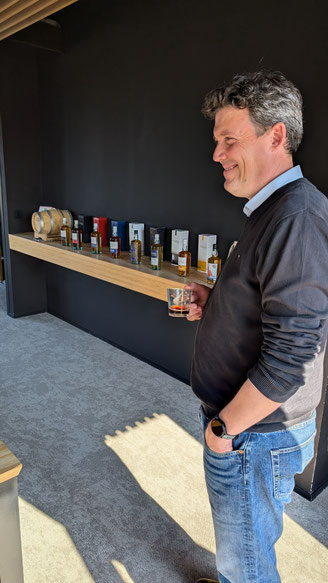
In the copper heart of Warenghem with David Roussier
David himself opens the door to the holy of holies. Behind a large glass wall bathed in natural light, the distillation installations—the beating heart of Warenghem—stand aligned. David leads us, his calm steps echoing on the tiled floor, the warm scent of wort still lingering.
We begin with the two traditional Scottish pot stills (designed in Scotland and built in Charente), true copper sculptures that gleam under the lights. “They are the backbone of our single malts,” David whispers to me, and their optimization required long hours of discussion with Jim Swan. He explains their two-pass operation: a first distillation to concentrate the alcohols, and a second to refine and reveal the aromas. Each of the two stills leaves its own signature: one rounder and more full-bodied, the other drier and spicier. These nuances allow Erwan Lefebvre, the master distiller, to skillfully orchestrate the complexity of Armorik’s aromatic profiles.
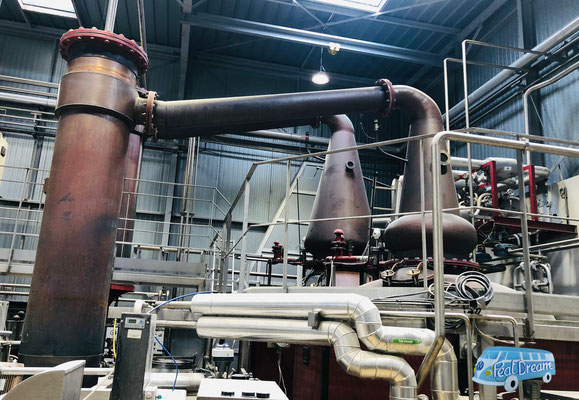
Since the distillery also produces more than just single malt, David shows us the other stills.
First, a plant still, used for herbal liqueurs and floral distillates—a nod to the brand's apothecary roots.

Then, tucked in a technical corner, a column still, used for grain spirits or fine de bretagne. Discreet but essential, it completes the distillery's toolkit.
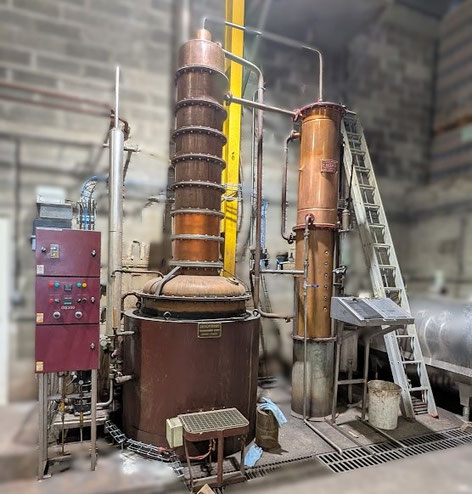
Next, we visit the brewhouse, installed in 2015. The air is warm, slightly humid, filled with malt and yeast. Here, the Water sourced from the granite bedrock beneath the distillery meets Breton malted barley, brewed with care to create sweet wort.
In large stainless steel vats, this wort ferments for several days, closely monitored by the production team. The magic happens in silence.
A small section catches the eye: pilot fermenters and a test tank. This is the future core of the slaughterhouse microbrewery, currently under development. There, Warenghem will experiment with new brews, locally inspired and always bold.
Tasting in the warehouse: where time shapes flavor
To end this immersive experience, David opens the doors to a modern warehouse.
The new aging cellars. The aroma is captivating: toasted wood, evaporating alcohol, and comforting humidity.
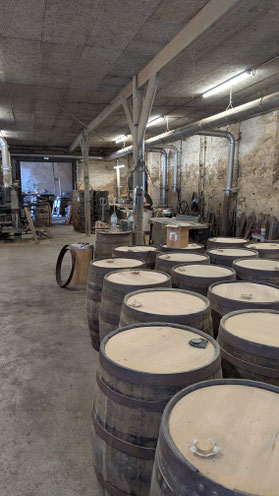
Barrels are stacked five high on racks that optimize space and ensure proper ventilation and aging consistency.
Sherry, bourbon, and port casks mingle here, along with experimental barrels from Lefloch's cooperage. Some marked only by number, others already legendary.
Though the distillery now has a stunning modern tasting room above the shop, we taste our samples among the green and orange-labeled casks.
ARMORIK 10 YEARS OLD: BRETON MATURITY IN A GLASS
In the filtered light of the warehouse, David hands us a bottle of Armorik 10 Year Old. "You must taste it here, where it grew," he says.
Crafted from a careful blend of single malts aged for ten years in sherry and American bourbon casks, Armorik 10 is bottled at 46%, non-chill filtered and with no added coloring.
This small-batch whisky is 100% Breton, shaped between sea and moor by Trégor's climate.
Before tasting, David proudly shares its honors: Gold at the 2022 World Whisky Masters (The Spirits Business), Gold at the 2023 Concours Général Agricole de Paris, and Gold at the 2024 inaugural World Drinks Award France (small batch 12+ years).
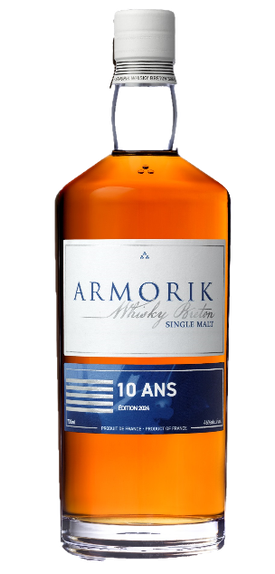
In the glass, it shines amber-gold.
The nose first suggests a fresh tarte Tatin, drizzled in warm salted caramel.
Then come stewed apples, vanilla, pastry cream, and a dry, woody note like polished Breton furniture.
A third sniff reveals a saline breeze—a reminder of the distillery's coastal home—wrapped in warm, indulgent roundness.
On the palate, the attack is smooth and creamy. Notes of honey, toasted almonds, ripe stone fruit, and a hint of saline minerality unfold. Breton oak adds a dry, balanced touch.
The finish is long and warm, echoing a decade in cask with lingering notes of dried fruits, hazelnuts, and toasted oak.
ARMORIK 15 YEARS OLD: BRETON DEPTH AT ITS PEAK
After the graceful Armorik 10, a new step awaits: Armorik 15 Year Old.
In this wooden cathedral of silence, whisky takes its time, and this expression has captured all its wisdom. David presents the bottle like an old friend. "This one’s the fruit of our most demanding patience. It speaks softly, but says a lot."
Crafted by Erwan Lefebvre from distillates aged 15 to 18 years:
47% spent 2 years in bourbon casks, then 13 years in STR Vinho casks
41% spent 15 years in bourbon, then 3 years in refill sherry
12% spent 15 years in bourbon, then 3 years in first-fill Spanish oak (a hidden 18-year-old!)
Bottled at 46%, unfiltered and uncolored, it stands as one of France's oldest single malts.

In the glass: deep copper-mahogany.
The nose evokes an antique library, with leather and polished wood.
Next come dried figs and black raisins in generous sherry.
Then bitter cocoa, nutmeg, smoky mocha, and a mentholated forest breeze.
On the palate: bold and sculpted. Black cherry jam on gingerbread, hints of licorice and leather. The wine-cask influence is present but harmonized by bourbon. A mineral tension grounds it in Brittany's granite.
The finish is long and noble, with blond tobacco, candied orange peel, and toasted wood, ending on subtle spice.
YEUN ELEZ CASK N°8366: SMOKED BRETON MIRE AND SPANISH SUN
After the cozy Armorik 15, we needed a slap of wind and peat from the Yeun Elez marshes.
In Warenghem's serene warehouse, some casks seem charged with memory. Cask N°8366, selected for this Yeun Elez Single Cask, was one of them.
Peaty and expressive, matured in a sherry cask and bottled at cask strength (59.8%) without filtration or coloring—a concentrated taste of smoky Brittany.
It earned Gold at the 2025 World Whisky Awards France.
Sold at Le Comptoir Irlandais, this edition quickly became a favorite for lovers of bold peat.

Its golden hue with amber glints reveals clear sherry influence.
On the nose, peat leaps out but remains controlled: oily smoke, pine resin, and worn leather.
Then sherry speaks: dried fruit and warm ash.
Finally, barley sugar, candied lemon zest, and a touch of smoky black tea.
On the palate: sharp, mineral, then smoky, with caramel, pepper, orange peel, and roasted nuts. Despite its 59.8% ABV, the alcohol is well-integrated.
The finish is long, straight, and slightly saline, evoking campfires and Benjamin Lefloch's barrel toasting.
This is Yeun Elez's most intense, unfiltered expression: bold peat balanced by finesse. For thrill-seekers or those craving true emotion.
As our senses still lingered in smoke, David moved toward the back casks, cooper-dog in hand.
The cask label was orange (peaty!) and bore number 858. It will be the next promising dram I'll taste. But that story is for another day...
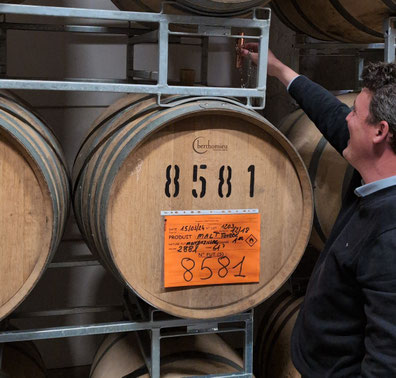
Climbing back into BRADPEAT (not right away—remember, drink responsibly!), it felt like closing a travel journal. Warenghem is not just a distillery.
It is a living story, a rare blend of tradition, innovation, and deep roots.
Whether you come for a dram, a tour, or a chat with Benjamin or David, you always leave with something: a taste, an idea, or the desire to return.
